RSyntaxTree has had a series of releases since the tidy layout post. The largest addition is support for attribute-value matrices (AVMs), the notation that HPSG and LFG are written in. A label can be cut into aligned columns, the value of an attribute can be another matrix nested to any depth, and a matrix can sit at any node of an ordinary tree.
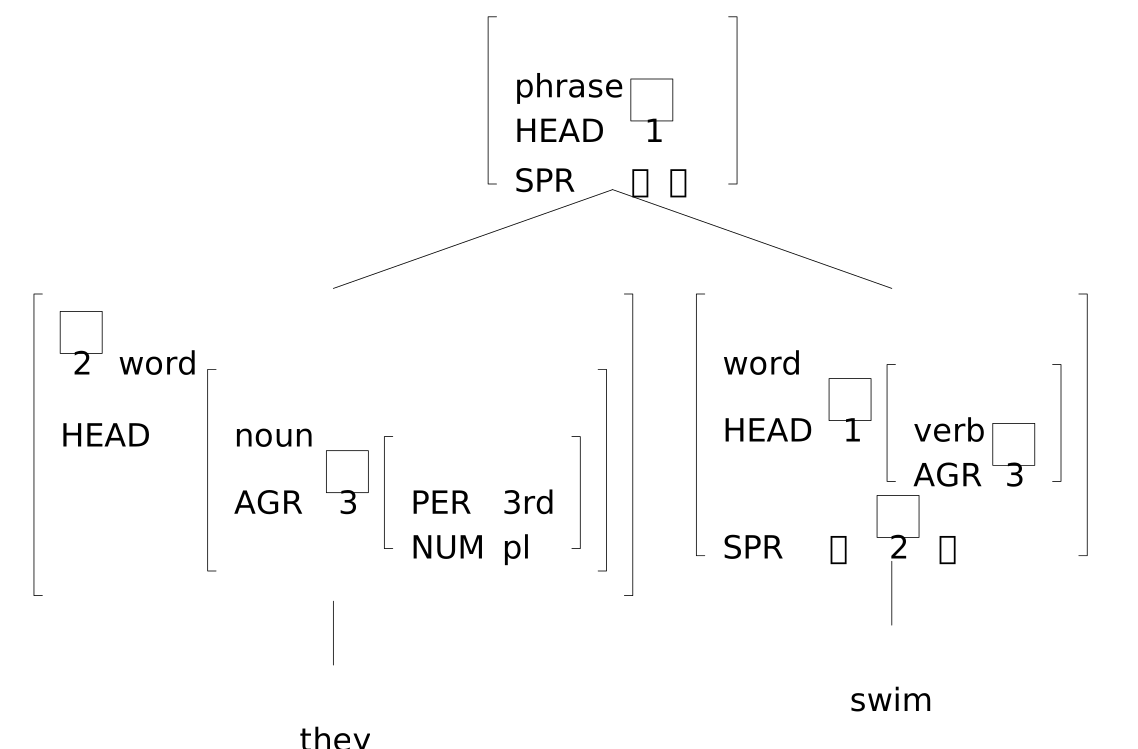
Here is They swim, the sentence Sag, Wasow and Bender (2003: ch. 3) use for the first worked example of their feature-structure grammar, drawn with the detail cut down to what the picture needs:
Input
[#*phrase*\
  HEAD\t|1|\
  SPR\t〈<>〉
  [#|2|<>*word*\
    HEAD\t#(*noun*\
    AGR\t|3|<>#(PER\t*3rd*\
    NUM\t*pl*#)#)
    they
  ]
  [#*word*\
    HEAD\t|1|<>#(*verb*\
    AGR\t|3|#)\
    SPR\t〈<>|2|<>〉
    swim
  ]
]
Each node is a matrix: a type in italics, then attributes and their values. A value can itself be a matrix. The HEAD of they is a noun object carrying an agreement matrix inside it. The boxed numerals mark structure sharing, two places in the description holding one value. Tag 1 says the HEAD of the phrase is the HEAD of the verb. Tag 2 says the item the verb's SPR (specifier) list asks for is the subject word itself. Tag 3 says the noun's agreement features and the verb's are the same thing.
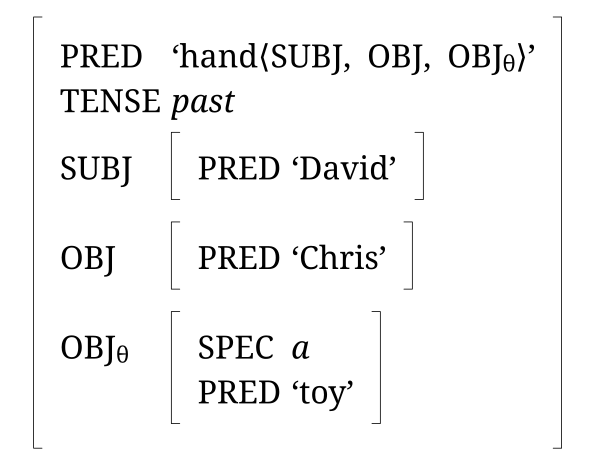
A label can also be nothing but a matrix, with no tree around it. This is the f-structure of David handed Chris a toy, after Bresnan (2001):
Input
[#PRED\t‘hand⟨SUBJ,<>OBJ,<>OBJ_θ_⟩’\
  TENSE\t*past*\
  SUBJ\t#(PRED\t‘David’#)\
  OBJ\t#(PRED\t‘Chris’#)\
  OBJ_θ_\t#(SPEC\t*a*\
  PRED\t‘toy’#)
]
Diagrams of this kind are usually prepared in LaTeX with packages like avm or langsci-avm. RSyntaxTree draws them from the same short bracket notation it uses for trees, in the browser, with SVG, PNG and PDF output. The notation is described in the documentation, and the example gallery has figures for HPSG and LFG, each listing the input and settings it was drawn from.
Bresnan, Joan. 2001. Lexical-Functional Syntax. Oxford: Blackwell.
Sag, Ivan A., Thomas Wasow, and Emily M. Bender. 2003. Syntactic Theory: A Formal Introduction. 2nd ed. Stanford: CSLI Publications.